HVAC Flywheel
When the Engineer writes Division 23, your name should already be in it.
A six-step marketing system for HVAC equipment manufacturers who want their products specified, quoted, and bought in commercial and institutional buildings.
Get Your Specifications Readiness Scorecard
What to Expect from HVAC Flywheel
Know Your Buyers
Identify every institutional owner in your territory who could specify your product in the next three years. Next, name the design firms who prepare their specifications. Every project is either open, won, lost, or unseen — and you must be aware of EVERY opportunity.
Know Your Losses
Every project you lose becomes a written record: which specifier, which reason, which competitor. No manufacturer keeps this list. Without it, you are relearning your own losses.
Know Your Score Monthly
One page. Specifications secured, quote dollars, close rate, revenue attributable to specification activity. Every month. In writing.
The HVAC Manufacturer Problem
You are not losing on price.
You are losing before price exists.
Somewhere in a facilities office at a university, a health system, a state agency or a commercial design firm, a document exists that decides whether your product is allowed on that campus for the next twenty years. It is called a design standard, a master specification, or a basis-of-design document. You have not read it. Neither has anyone on your team. The engineer specifying your competitor’s product last month did.
VISIBLE SYMPTOMS
You are quoted less often than you should be. When you are quoted, you win less than your product quality would predict.
WHAT IT FEELS LIKE
You find out you lost a project when the job is already someone else’s. You have nothing to say that survives a follow-up question.
WHY THIS IS WRONG
A product engineered to a higher standard should not lose to a product named in a document your team has never read. The market is not measuring the product. The market is measuring who documented themselves into the specification first.
THE DEVIL YOU DON’T KNOW
The design standard you have never read. Written years ago in a facilities office by an engineer whose name you do not know. Deciding whether your product is allowed, section by section, for the service life of every building on that campus. Not personal. Not malicious. Documentary — and unchallenged, because you did not know it existed.
We Focus on What Matters: Results
We Understand Your Frustration
Losing before price exists is not a marketing problem. It is a documentation problem, and it compounds every year the standard is not challenged. We see manufacturers with objectively superior products lose over 90% of the opportunities in their market. Why? Because a specifier wrote three sentences in 2010 no one updated.
Because We’ve Sat by Your Side
Our team has worked in specification-driven markets for over four decades. We are marketers, but have sat side-by-side with HVAC manufacturers to win more projects faster. We do not sell hours, but operate a six-step system on your behalf to bring your products out of the file drawer and on to the design table.
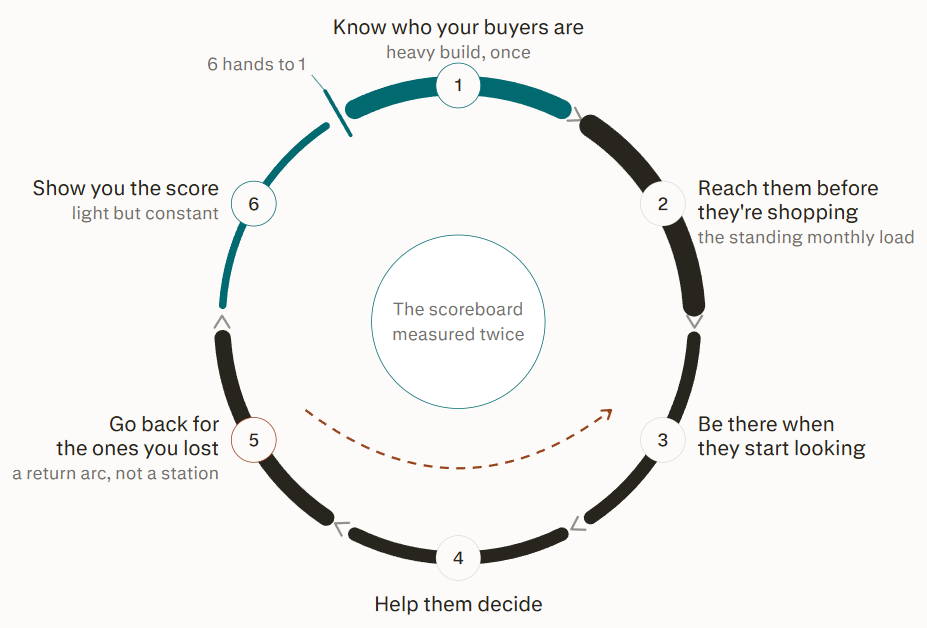
The six steps of a specification practice
1
Know Who Your Buyers Are
A written list of the commercial and institutional owners in your territory who could specify your product in the next three years — matched to the design firms who prepare their specifications.
2
Reach before they’re shopping
Technical education, placed advertising in the publications specifiers read, and CEU-accredited content that reaches engineers years before a project exists.
3
Be there when they start looking
Ungated Revit families, ungated three-part guide specifications, first-page presence when specifiers search — and a technical response within one business day with documentation attached.
4
Help them decide
Substitution-request templates that survive engineer scrutiny, page-referenced comparisons against three-name specifications, and reps who can name the three most common objections without checking.
5
Go back for the ones you lost
A written record of every project you were quoted on and did not win — with the specifier’s own reason. Plus the installation and commissioning content that keeps the ones you won from being re-opened in the next standard revision.
6
Know your score monthly
A monthly one-page read of specifications secured, quote dollars, close rate, and revenue attributable to specification activity — with the denominator stated, and last year’s number next to this year’s.
Steps 1 and 6 are the same measurement taken twice. What you set out to know at the beginning is the number you are held accountable to at the end.
Push and pull are expenditures. A specification is an asset. Push marketing pays for attention; pull marketing pays to be found; both are billed monthly and both stop working the day you stop paying. A specification, once written, works every day for the fifteen to twenty-five year service life of the equipment it names. This practice is engineered to produce the third mode: not attention, not discovery, but position. That is why the score is written in specifications secured, not impressions delivered.
What continues if nothing changes?
A design standard that excludes your product does not expire when your product improves.
It is reviewed every five to fifteen years by an engineer who inherited the last version — and the last version does not name you.
Every project on the excluded campus is a project you cannot quote for the service life of every piece of equipment currently installed. Not one project. Every project.
You will continue to be asked, quarterly, what marketing produced this year. Without the score, the answer will continue to be a version of “hard to say.”
THE COMPOUNDING COST CARD
The compounding cost of a specification you did not write.
20 · Years of building service life
The typical operating window during which the equipment specified today will be replaced in-kind, section-by-section, by the same document.
5–15 · Years between standard revisions
The window during which the specification is functionally frozen. If your name is not in it now, it will not be in it for a long time.
0 · Meetings scheduled to change it
Not by you, not by your rep, not by anyone in the market. Which is precisely why it stays written the way it is.
Before you decide, see where you actually stand
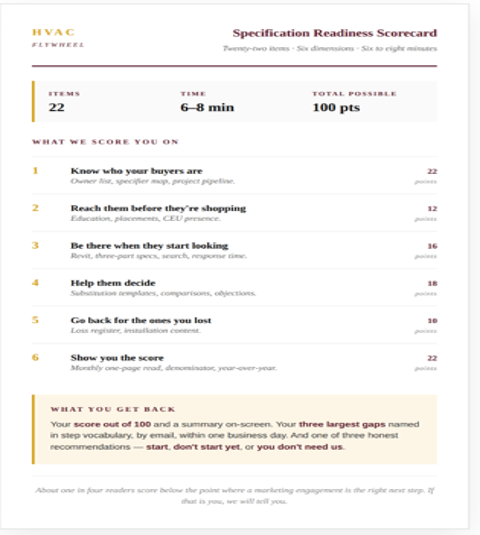
The Specification Readiness Scorecard is a written read of your current specification practice across the six steps. Twenty-two items. Six to eight minutes.
You will see your score and a summary the moment you finish. If you want the full written read — three specific gaps named in your own step vocabulary and how manufacturers typically close them — we send it by email within one business day.
The Scorecard produces one of three outcomes.
- If your score suggests you are already producing a measurable read, the honest answer is an engagement may not be your next best investment, and the report will say so.
- If your score suggests your gaps are foundational rather than tactical, the honest answer is a marketing program will not fix them, the report will name what should be done.
- If your score lands in the middle of the pack — where most manufacturers land — the report will name your three largest gaps and the direct you to request a detailed proposal.
No credit card. No obligation. Instant score. Written read within one business day.