Step 4 | THE DECISION WINDOW
Arm Your Reps. Don’t Run Them.
Step 4 is the shortest window in the flywheel and the most decisive. Weeks or months, with a clear beginning, middle, and end. Everything upstream either pays off here or it does not.
Get Your Specifications Readiness Scorecard

Why HVAC manufacturers lose at the moment of decision
The specification is being written. The competitive set is short.
A specifier is comparing three or four manufacturers on technical merit, on installation risk, on documentation quality, on how easy each one is to work with when a question arises.
The specification is either won or lost in these weeks.
Most manufacturers do not know a project is in this window until the bid drops.
The rep may know. The rep may not. The rep may know but may not have the documents to defend the basis-of-design when a competitor challenges it.
The rep may make the call to marketing and get generic collateral that was written for a category, not for this project.
You are not losing on price.
You are losing before price exists — in the weeks the specification is being written, when the rep who should be answering the specifier’s hardest questions is instead scrambling to find the right document.
What our practice does at Step 4
Step 4 is the decision window of the flywheel. Where Steps 1–3 build presence and readiness, Step 4 arms your sales force with the specific tools they need to win the specifications your engineers are competing for right now.
Enablement documents, active-project briefings, substitution defenses, decision-support content for every product line into every building type. Engineer-fluent writing from Bill Merrow. AI-native production that makes the volume possible. Client engineering team review and signature on everything.
We arm your sales force with every marketing tool they need to win specifications. We do not run your sales force. That boundary is the point, not a limitation. You know your reps, your territories, your compensation, your promises to your dealer network.
We know how to make the specifier reach for your product at the moment the specification is being written. Step 4 is where those two capabilities join.
Our 6-Step Process
1 | The Decision Support Library
The baseline artifact of Step 4. For every product line your organization sells into every building type you target, a library of decision-support documents:
Technical selection guides, failure-mode analyses, reference project write-ups, honest competitive comparison sheets (naming competitors and their strengths, because specifiers already know what those are), substitution-defense templates, and specifier FAQ documents.
Bill-led writing with AI-native production. Refreshed as products, standards, and competitors evolve. What your rep needs, ready before they need it.
2 | The Signal-to-Action Library
The trigger infrastructure.
A written protocol that names every observable signal — downloads from platforms specifiers use, Working Room activity from Step 3, timeline intelligence from Step 1’s Owner List, external signals surfaced by the practice’s listening infrastructure — and specifies what fires when the signal appears.
Signal, responsible party, action, timeline.
A living document, updated as the practice learns which signals actually predict specifier action for your product lines.
Removes ambiguity in the moment that matters most.
3 | The Rep Enablement Kit
Not sales training.
A decision-stage recognition guide that teaches your reps to identify what stage the specifier is in, and which document from the Decision Support Library to bring to which conversation.
Reinforced quarterly with anonymized real examples across the practice’s client base.
Your reps stop guessing which document to send and start knowing which one the specifier is ready to read.
4 | The Active Project Briefing
The trigger-activated deliverable. When a project fires — through any of the four signal sources — the practice produces a same-week briefing for your rep.
Who the specifier is (from your Specifier Map). What the project appears to be. Competitive landscape. Your angle. The specific documents the rep should bring.
Recommended sequence of touches over the next four to six weeks. One to two pages. The rep walks into the specifier conversation prepared, not scrambling.
5 | The Substitution Defense
The most consultative work the practice does, and the one Step 4 deliverable no other fractional or agency will match.
When a competitor challenges your specification with an approved-equal request at bid, Bill writes the substitution defense with your engineer.
Reads the substitution request. Extracts the technical case in a working session with your engineer. Writes the defense in specification-defensible language, iterating until it is right. Advises on filing strategy, timing, and the cc list.
Follows up when the specifier or owner asks a technical question. This is the argument that decides whether a won specification holds through bid or becomes a last-minute loss.
Every substitution defense your organization needs. No caps, no volume framing, no scope conversation. The retainer defends the specifications you win.
6 | The Decision Score
Monthly, one page, delivered five business days after month-end.
Active Project Briefings produced this month. Specifications won. Specifications lost, with the reason.
Substitution defenses filed and their outcomes. Which triggers most reliably preceded a spec win.
The Decision Score becomes Step 4’s slice of the Monthly Accountability Review that runs the whole flywheel — and over time, it becomes the clearest measure of whether the practice is earning its fee.
What makes Step 4 different from sales-enablement programs you have been pitched
Every marketing agency will offer you sales enablement. Every content firm will offer you a battlecard library. Every marketing automation platform will offer you sales-signal alerts. If any of it had worked, your reps would already be walking into specifier conversations with the documents they need and the intelligence they need. They are not, because none of it is built on what makes Step 4 actually work.
Three things separate Step 4 from the sales enablement programs you have been pitched.
One, the documents are written by an engineer, for engineers, about your specific products.
The Decision Support Library is not templated. It is not written by copywriters who understand HVAC categorically.
Bill writes it — engineer-to-engineer — for your product lines, your building types, your competitive set.
When your rep hands a specifier a comparison sheet, the specifier reads it and can tell within one page whether the person who wrote it understood the technical stakes. Yours will.
Two, the intelligence comes from the flywheel, not from a database.
The Active Project Briefing your rep receives on a live opportunity is built from your Specifier Map (Step 1), your engagement history with the specifier (Step 3), the design-standard revision timeline (Step 1’s Owner List), and the listening infrastructure the practice builds and reads.
No purchased database contains any of this. No sales-intelligence platform can produce it.
The briefing is possible because the flywheel is running — and it is the reason the flywheel earns its fee at this step.
Three, the boundary is honest, and it protects both sides.
We arm your sales force. We do not run your sales force. You keep sales leadership — the reps, the territories, the compensation, the accountability.
We build the enablement infrastructure that makes your reps formidable in specification battles.
The boundary is not a limitation; it is what keeps the practice good at what it does, and what keeps you in charge of the operation you should be in charge of.

What you have after Year One of Step 4
A Decision Support Library covering every product line your organization sells into every building type you target, refreshed as products and standards evolve.
A written Signal-to-Action Protocol naming every observable trigger and specifying what fires — responsible party, action, and timeline.
A Rep Enablement Kit that trains your reps to recognize which decision stage a specifier is in and which document to bring to which conversation.
Same-week Active Project Briefings whenever a project fires, so your rep walks in prepared instead of scrambling.
Every substitution defense your organization needs, written by Bill with your engineer, whenever a competitor challenges one of your specifications at bid.
A monthly Decision Score showing specs won, specs lost with reasons, substitution outcomes, and which triggers most reliably preceded a win.
A sales operation that is genuinely more formidable than it was twelve months earlier — without your sales leadership losing an ounce of control over its own team.
Before you decide, see where you actually stand
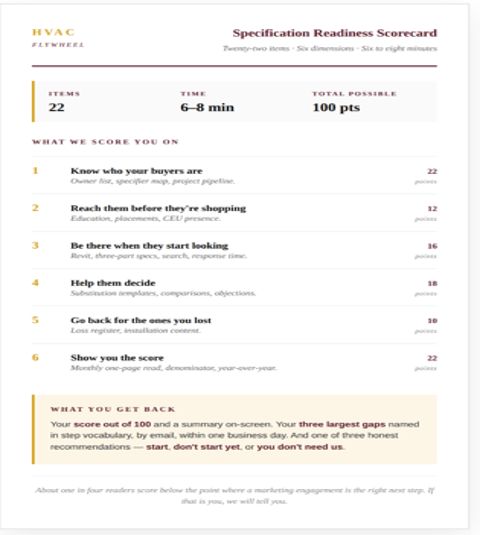
The Specification Readiness Scorecard is a written read of your current specification practice across the six steps. Twenty-two items. Six to eight minutes.
You will see your score and a summary the moment you finish. If you want the full written read — three specific gaps named in your own step vocabulary and how manufacturers typically close them — we send it by email within one business day.
The Scorecard produces one of three outcomes.
- If your score suggests you are already producing a measurable read, the honest answer is an engagement may not be your next best investment, and the report will say so.
- If your score suggests your gaps are foundational rather than tactical, the honest answer is a marketing program will not fix them, the report will name what should be done.
- If your score lands in the middle of the pack — where most manufacturers land — the report will name your three largest gaps and the direct you to request a detailed proposal.
No credit card. No obligation. Instant score. Written read within one business day.