Step 1 | The Foundation
Know Who Your HVAC Buyers Are
The specifiers who write your competitors into design standards are named, reachable, and predictable. Most manufacturers do not know who they are. The practice starts here.
Get Your Specifications Readiness Scorecard

What most manufacturers do
Most commercial and institutional HVAC manufacturers know their buyers as categories.
Hospitals. Universities. K-12 school districts. Municipal buildings. Data centers. Manufacturing plants.
They know the categories well enough to build sales territories around them.
What they do not know, by name, is which mechanical engineer at which design firm writes the Division 23 standard for each of the top 200 buyers in their territory.
They do not know when that standard was last revised, what it currently specifies, or when it is next scheduled to be reviewed.
They do not know which specifiers on that list have retired, which have moved firms, or which junior engineers are now writing the specifications their senior colleagues used to write.
Their competitors, meanwhile, are already written into those standards. Not because the competitors have better products.
Because they were present in the specifier’s professional life during the six months that mattered, and they were the manufacturer the specifier could confidently name when it was time to write the standard.
You are not losing on price. You are losing before price exists. And you are losing because the people writing the specifications do not know you as well as they know your competitors.
What our practice does at Step 1
Step 1 is the practice’s foundation and its heaviest single build. Once completed, it is refreshed continuously but never rebuilt. Every other step in the flywheel depends on it.
The practice identifies every institutional and commercial building owner in your target market who writes their own HVAC design standard.
It maps the mechanical engineer of record at every design firm writing those standards, by name.
It reads every design standard those specifiers have written.
And it produces three written artifacts for every standard read, each one calibrated for a specific audience inside your organization.
That library, updated on a written maintenance cadence, becomes the foundation of every conversation the practice has with the specifiers on your behalf for the life of the engagement.
Our 7-Step Process
1 | Territory
We define your market by geography, building type, and account size, then apply your qualification thresholds.
The result is a written territory definition your sales leadership, your rep network, and the practice all work from without ambiguity.
2 | Owner List
Every institutional and commercial building owner in your territory who writes their own HVAC design standard is identified by name, with the standard they use, when it was last revised, when it is next scheduled for revision, the capital-planning cycle they operate on, and the internal facilities engineer or director who owns it.
The list is not a database purchase. It is built by the practice through primary research, public-records review, and direct outreach where necessary.
3 | Specifier Map
For every owner on the list, the design firm holding the current relationship is identified, and the specific mechanical engineer of record who writes the Division 23 specification is named.
Historical relationships are captured: which specifier wrote the prior version of the standard, where they work now, which junior engineers on the current team are likely to become tomorrow’s primary specifiers.
The Specifier Map is the practice’s core operating asset. Every other step in the flywheel operates on the specifiers named here.
4 | Read
Every design standard on the Owner List is read in full by our practice. Not skimmed. Not summarized from a table of contents.
Read, in the way an engineer reads a specification when they are preparing to defend or challenge it. What the standard names as basis-of-design. What it excludes. What performance criteria it requires. What substitution language it accepts.
What the specifier’s technical preferences and objection patterns reveal. If the list has ten standards, we read ten. If it has thirty, we read thirty. If it has a hundred, we read a hundred at a pace of one per day after collection is complete.
The calendar bends to the size of the list. What we produce for every standard does not change based on the volume.
5 | Artifacts
For every standard read, the practice produces three written artifacts, each calibrated for a specific audience:
The One-Page Summary. A single-page PDF summarizing the standard: what it names as basis-of-design, what it excludes, key performance criteria, substitution language, and the specifier’s stance. For your leadership team and account executives to review before every specifier conversation.
The Engineer Version. The full technical read, written for engineer-to-engineer conversations. Names the mechanical assumptions built into the specification, identifies where your product performs above and below the current basis-of-design, and provides the technical case your engineering team can make when engaging the specifier directly.
The Field Version. Written for your internal reps and external rep firms. What to say in a specifier conversation. What documents to bring. What objections to expect. What technical points your engineering team will back up if asked. Turns your rep force into the informed partners your specifiers want to talk to.
All three artifacts are delivered at Baseline. No tiering. No premium version. Every standard we read produces all three artifacts, every time
6 | Your Buyer Book
Territory, Owner List, Specifier Map, and every artifact from every standard read are assembled into one operating document: the Buyer Book.
It is your organization’s living knowledge base of who buys what you make, who writes their standards, what those standards currently say, and what changed in the last month.
Your leadership team, your engineers, your marketing team, and your rep network operate from the same document. So does the practice.
7 | Maintenance
The Buyer Book is refreshed continuously. Specifier movements are tracked. Standards revisions are captured within the month they occur. New owners entering your territory are added. Retirements, firm changes, and successions in the Specifier Map are updated as they happen.
The Baseline is the heavy build; maintenance is the standing monthly load that keeps it accurate. What we deliver in Year One becomes more valuable, not less, in Year Three and Year Five, because the specifier relationships and historical context compound with time.
What makes Step 1 different from what you have tried before
You have probably paid for buyer lists before. You have paid for market research reports. You have paid for CRM data enrichment.
None of it produced what Step 1 produces, for one reason: none of it involved reading every standard your buyers actually write.
The read is the differentiator. Not the list. Anyone can buy a list of hospitals. Anyone can scrape LinkedIn for mechanical engineers.
What no one else does is the disciplined, engineer-fluent reading of every actual design standard those engineers have written, translated into audience-specific artifacts your organization can actually use.
The practice identifies every institutional and commercial building owner in your target market who writes their own HVAC design standard.
It maps the mechanical engineer of record at every design firm writing those standards, by name.

What you have after Year One of Step 1
A written territory definition your entire sales operation works from.
A named list of every owner in your territory who writes their own standard, with the standard, its revision cycle, and its capital-planning context.
A Specifier Map naming every mechanical engineer of record on those standards, with historical relationships and succession tracking.
Three written artifacts for every design standard read: the One-Page Summary, the Engineer Version, and the Field Version.
The Buyer Book as your operating document, refreshed monthly, accessible to every team that needs it.
A foundation the other five steps of the flywheel operate on top of, without which nothing else in the practice can succeed.
Before you decide, see where you actually stand
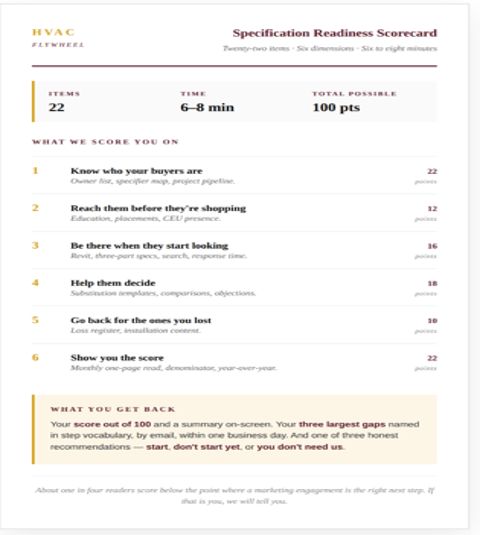
The Specification Readiness Scorecard is a written read of your current specification practice across the six steps. Twenty-two items. Six to eight minutes.
You will see your score and a summary the moment you finish. If you want the full written read — three specific gaps named in your own step vocabulary and how manufacturers typically close them — we send it by email within one business day.
The Scorecard produces one of three outcomes.
- If your score suggests you are already producing a measurable read, the honest answer is an engagement may not be your next best investment, and the report will say so.
- If your score suggests your gaps are foundational rather than tactical, the honest answer is a marketing program will not fix them, the report will name what should be done.
- If your score lands in the middle of the pack — where most manufacturers land — the report will name your three largest gaps and the direct you to request a detailed proposal.
No credit card. No obligation. Instant score. Written read within one business day.