Step 2 | THE STANDING MONTHLY LOAD
Reach Them Before They’re Shopping
By the time a specifier is comparing HVAC products, the specification is already being written. Step 2 is how you become the manufacturer they already know.
Get Your Specifications Readiness Scorecard

Why most manufacturers are invisible during the six months that matter
Every commercial and institutional HVAC specification has a pre-shopping window. It begins six to eighteen months before the product comparison starts. During that window, the specifier is reviewing continuing-education material to renew their AIA credits.
They are reading manufacturer-neutral technical guidance on ARCAT, in trade press, and on industry association websites.
They are attending regional AIA chapter events and lunch-and-learns.
They are searching open-web sources for guidance on new standards, new refrigerants, new efficiency requirements, new project types they have not designed for before.
By the time they are on your product page comparing you to your two closest competitors, the specification is already ninety percent written.
Your product page did not lose the spec.
Your absence from the six months before the specification opened is what lost it.
Most manufacturers are not present during that pre-shopping window because they cannot see it.
Their marketing analytics show product-page traffic, form submissions, and download counts.
Those metrics report on the last five percent of the buying process.
The first ninety-five percent is invisible to them, so it is invisible to their marketing budget.
You are not losing on price. You are losing before price exists. Step 2 is how you become present during the months when the specification is being written, not the days when the product is being chosen.
What our practice does at Step 2
Step 2 is the flywheel’s standing monthly load. Not a one-time build like Step 1. A continuous engine of content, credentialing, and platform presence that runs every month for the life of the engagement, and that compounds in value with every month it operates.
The practice audits every closed platform where specifiers do their pre-shopping work and every open-web surface where they search for technical guidance, identifies where your organization is present and where you are absent, and builds a monthly content-and-credentialing program that establishes your brand as a routine part of the specifier’s professional life.
When the specification opens, you are not the manufacturer being introduced. You are the manufacturer the specifier has been reading, watching, and learning from for months.
Our 6-Step Process
1 | The Visibility Baseline
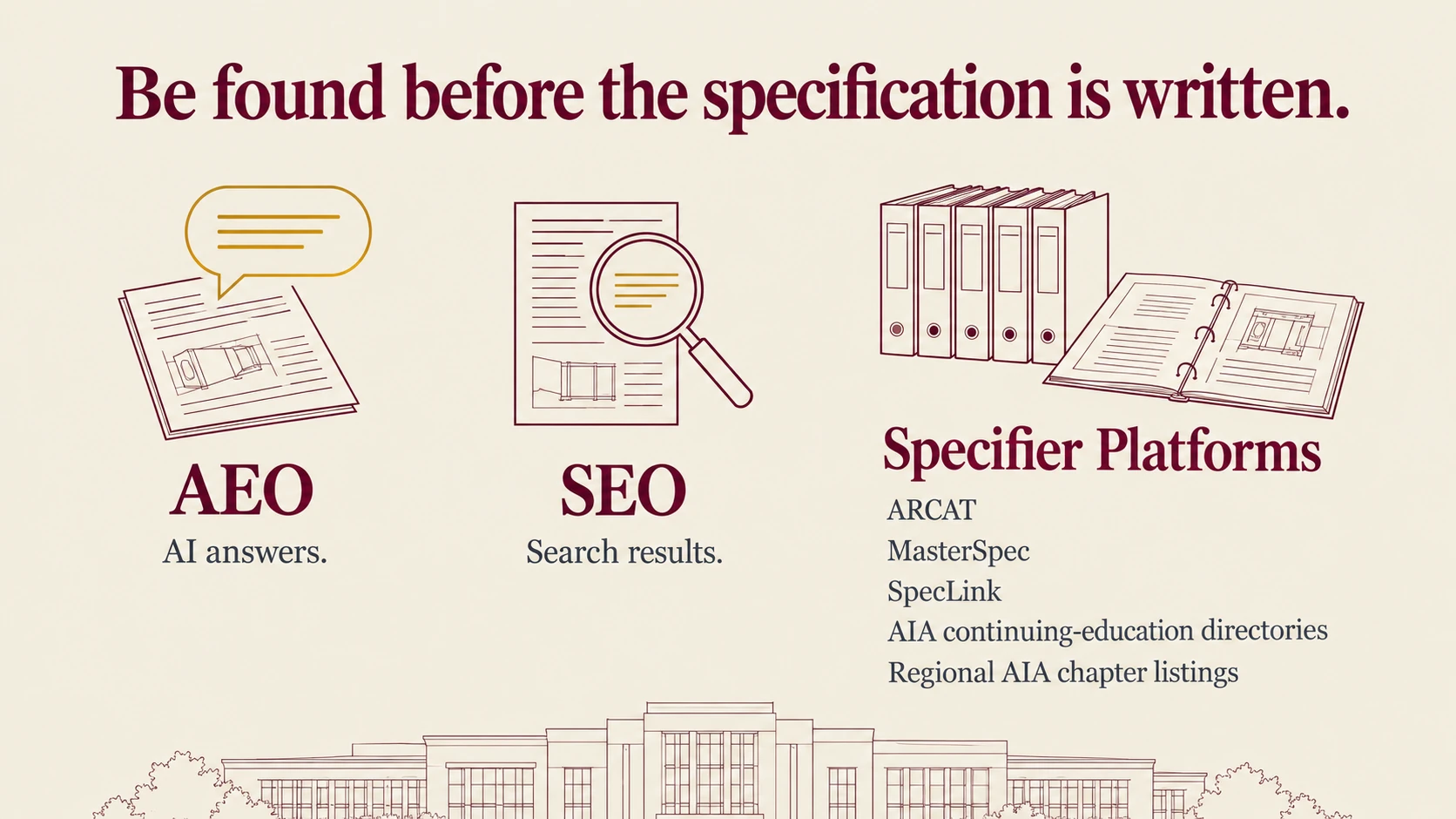
Every engagement begins with a written baseline of your organization’s current presence on the closed platforms specifiers use (ARCAT, MasterSpec, SpecLink, AIA continuing-education directories, regional AIA chapter listings) and on the open web (search visibility for the technical topics your specifiers research, AI-search citation presence for the questions specifiers ask AI tools, trade-press mention frequency, industry association participation).
The baseline produces a written scorecard:
- Green means you are present and performing;
- Yellow means you are present but under-performing;
- Red means you are absent entirely.
Nothing gets scoped or budgeted until the Visibility Baseline is complete.
2 | The Findability Fix
Every Red and Yellow finding from the Visibility Baseline gets a written fix plan: what changes, who does it, by when, and what it will produce.
Product data on closed platforms gets updated to current specification standards.
Missing platform presence gets built.
Search-optimized content gets published to fill the gaps where specifiers are searching and finding your competitors instead.
This is one-time-per-gap work; once fixed, a gap moves to Green and stays there with monthly maintenance.
3 | The Author Practice
The heart of Step 2. Every month, the practice produces published content in your organization’s voice — technical articles, standards-update analyses, case studies, and educational pieces — that answer the specific questions specifiers are asking during their pre-shopping months.
Written by the practice, reviewed and signed by your engineering team, published under your organization’s byline.
Not thought leadership as a marketing category. Genuine engineering-fluent writing on the technical topics your specifiers are actively researching.
Published on your site, syndicated to trade press where placement is available, and repurposed into the formats specifiers actually consume — short video, one-page PDFs, LinkedIn posts, and the CE course content produced in the next process step.
4 | The AEO Layer
AI search — Perplexity, ChatGPT, Claude, Gemini — is where a growing share of specifier pre-shopping research now happens.
The practice runs a monthly Answer Engine Optimization program: identifying the specific technical questions specifiers ask AI tools, testing whether your organization is currently cited in the answers, and producing the structured content that makes your organization the source AI models cite when specifiers ask.
Bill Merrow leads this work personally. It is the most novel and highest-leverage component of Step 2, and it is where most competitors are not yet operating.
5 | The Feed
Two to four times per year, the practice produces a continuing-education course accredited for AIA credit — the credit currency specifiers must renew annually.
Course production runs an AI-native research and content-assembly workflow, engineer-reviewed at every step. AIA registration fees are paid by your organization directly.
Courses are delivered through the AIA continuing-education platform and offered as lunch-and-learns to design firms in your territory.
Every course is a full pre-shopping event: an hour of the specifier’s professional development time spent with your organization as the presenter, the technical authority, and the manufacturer solving the problem the course addresses.
6 | The Discovery Score
Monthly, one page, delivered five business days after month-end. What we did last month. What it produced. What we’re doing next.
Platform findability scores across every closed platform and open-web surface, tracked month over month. AEO citation counts for the specific questions we are targeting.
Content published, distribution reached, CE course registrations, and lunch-and-learn deliveries.
The Discovery Score becomes Step 2’s slice of the Monthly Accountability Review that runs the whole flywheel.
What makes Step 2 different from the SEO you have paid for before
You have paid for SEO. You have paid for content marketing. You have paid for AI-search visibility work from at least one vendor who told you they had it figured out. If any of it had worked, you would not be reading this page. Three things separate Step 2 from what you have paid for before.
One, closed platforms and open web are treated as one job.
ARCAT presence is not a product-marketing task while search rankings are a marketing task.
They are the same job, because they serve the same specifier during the same pre-shopping window.
The Visibility Baseline treats both surfaces as a single findability score.
Two, the content is engineer-fluent, not marketing-fluent.
Every piece of published content is written by Bill Merrow personally or drafted under his direct supervision, then reviewed and signed by your engineering team.
Nothing goes out under your organization’s byline that Bill or your engineers would not have written themselves.
The specifier reading it can tell the difference within the first paragraph, which is exactly why generic SEO content does not produce specification wins.
Three, results are visible in the Monthly Accountability Review, not defended in a quarterly report.
Every month, the leadership team sees exactly what was published, exactly where it appeared, exactly what it produced in findability and AEO citation terms, and exactly what is planned for the coming month.
What we did last month. What it produced. What we’re doing next.
No mystery, no dashboards nobody looks at, no annual reviews where the practice tries to justify twelve months of activity in one meeting.
What you have after Year One of Step 2
A written territory definition your entire sales operation works from.
A written Visibility Baseline scoring your presence on every closed platform and open-web surface specifiers use.
Every Red and Yellow finding fixed and moved to Green, with monthly maintenance keeping them there.
Twelve months of published content in your organization’s voice, engineer-signed, distributed across the platforms specifiers pre-shop on.
A monthly AEO program that increases the frequency your organization is cited when specifiers ask AI tools their pre-shopping questions.
Two to four AIA-accredited continuing-education courses delivered as lunch-and-learns to design firms in your territory.
A monthly Discovery Score showing what you did, what it produced, and what is coming next — reviewed with your leadership team every month.
Presence in the six-to-eighteen-month window where the specification is being written, not the six weeks when the product is being chosen.
Before you decide, see where you actually stand
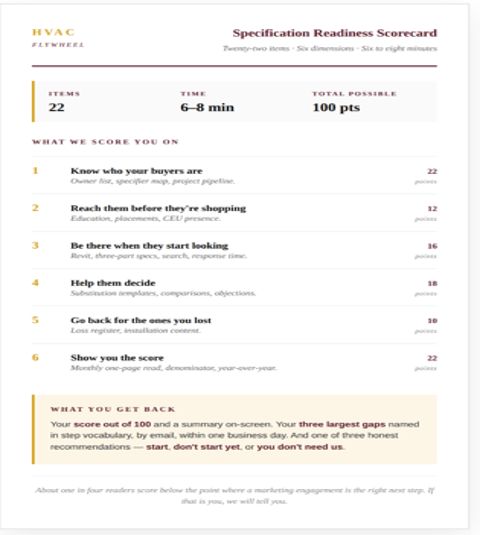
The Specification Readiness Scorecard is a written read of your current specification practice across the six steps. Twenty-two items. Six to eight minutes.
You will see your score and a summary the moment you finish. If you want the full written read — three specific gaps named in your own step vocabulary and how manufacturers typically close them — we send it by email within one business day.
The Scorecard produces one of three outcomes.
- If your score suggests you are already producing a measurable read, the honest answer is an engagement may not be your next best investment, and the report will say so.
- If your score suggests your gaps are foundational rather than tactical, the honest answer is a marketing program will not fix them, the report will name what should be done.
- If your score lands in the middle of the pack — where most manufacturers land — the report will name your three largest gaps and the direct you to request a detailed proposal.
No credit card. No obligation. Instant score. Written read within one business day.