Step 3 | THE READY-WHEN-TRIGGERED ENGINE
Be There When They Start Looking
When a specifier opens the design standard, the CE catalog, the substitution request, or their inbox: you are there, current, and easy to work with.
Get Your Specifications Readiness Scorecard

Why “nurture” is the wrong word for what specifiers actually do
A specifier is not a lead. They do not need to be warmed up. They will not be moved down a funnel.
They touch your product category four or five times a year — writing a spec, answering an approved-equal request, attending a CE course, taking a call about a live project — and they need you to be present, useful, and current in those moments.
The other three hundred and sixty-one days of the year, they need you to leave them alone.
Every “specifier nurture program” you have been pitched has failed for this reason.
Specifiers see marketing automation the same way engineers see marketing automation.
They know what it is. They know why it exists. They know it was not written to help them.
And they know that a manufacturer sending them any drip sequence, of any length, has fundamentally misunderstood who they are and how they work.
Step 3 solves the actual problem, not the marketing-automation-shaped fantasy of it.
We build a set of engagement assets that are ready when the specifier is ready — videos they can watch in five minutes when a question comes up, field documents they can find the answer in inside sixty seconds, a shared workspace they can bring a live project question to, a light standing correspondence engineer-to-engineer that respects their time.
Present when needed, absent when not. This is what engagement with specifiers actually looks like.
What our practice does at Step 3
Step 3 is the ready-when-triggered engine of the flywheel. Where Step 2 runs continuously to build presence across the six-to-eighteen-month pre-shopping window, Step 3 builds and maintains the specific engagement assets a specifier reaches for when a moment fires — a live project, a substitution question, a CE credit renewal, a technical question about a product line.
The practice maps every touchpoint your organization currently has with the specifiers on your Specifier Map, identifies where you are present and where you are absent, and builds the artifacts that make you the manufacturer the specifier reaches for by name. Engineer-fluent writing from Bill Merrow. AI-native production that makes the volume possible. Client engineering team review and signature on everything. What comes out is a body of engagement content specifiers actually want.
Our 6-Step Process
1 | The Engagement Map
Every engagement begins with a written map of every touchpoint your organization currently has with specifiers, scored against every touchpoint you should have.
Email cadence to the Specifier Map (existing or missing, clean or not).
Video content (current and specifier-relevant, or dated and generic).
Installation and operating manuals (usable in the field, or embarrassing when a specifier opens them).
AIA continuing-education courses (approved and current, or expired).
Shared workspaces with your top specifier relationships (built and used, or nonexistent).
LinkedIn presence beyond one-off posts. Tradeshow presence.
Everything a specifier expects to find when they reach for it.
The Engagement Map is one of several baseline documents the practice builds early in the engagement — alongside the Buyer Book from Step 1 and the Visibility Baseline from Step 2.
2 | The Cadence
Bi-weekly correspondence to the Specifier Map from Step 1. Bill Merrow drafts each piece engineer-to-engineer; your engineering team edits for voice and technical positioning; your engineer signs and it goes out.
Not a newsletter. Not a drip sequence. Substitution wins on projects the specifier will care about, regional design-standard updates, code changes affecting Division 23, CE course reminders keyed to their credit-renewal cycles.
Every piece is something the specifier is genuinely better off having read.
A one-line courtesy unsubscribe at the bottom — because respect for the specifier’s inbox is not optional.
When the Specifier Map from Step 1 updates, the Cadence list updates.
3 | The Reference Library
Short — three to seven minutes — tight, specifier-relevant videos. Each answers one question a specifier actually asks.
Bill scripts each video and iterates until it meets his own “would I put my name on this” bar.
Produced through an AI-native video workflow that makes the volume possible without sacrificing the quality that makes videos worth watching.
Available on demand, embedded in installation manuals, linked from CE courses, findable on YouTube for the AEO layer.
A body of reference content that grows every quarter and becomes, over time, the place specifiers go when they have a question about your category — regardless of which manufacturer they are specifying that day.
4 | The Field Documents
Installation manuals, operating manuals, submittal packages, warranty documentation — rewritten to be useful rather than encyclopedic.
A specifier or installer finds the answer to any operational question inside sixty seconds. The full technical document still exists for the audit trail. Every document dated and versioned.
This is the work traditional HVAC manufacturers most often let atrophy — because it is unglamorous, because engineers write it once and never revisit, because marketing departments treat it as production overhead.
When a specifier’s installer struggles with your submittal package on a live project, the specifier remembers.
5 | The Working Room
For your deepest specifier relationships, a shared collaborative workspace — Slack, Teams, or a lightweight alternative — where your engineers and the specifier’s engineers work together on live specification questions.
The practice builds the prototype for your product line, pours the foundation (platform, channel structure, initial content, response protocols), trains your team on how to run it, and drafts the invitation your team sends.
Your team runs the room; your team staffs it; your team responds.
The practice reviews room health quarterly and coaches on specific interactions when needed — but is never visible inside the room, because the moment the practice is visible, the engineering-to-engineering trust that makes the room valuable disappears.
6 | The Engagement Score
Monthly, one page, delivered five business days after month-end.
What the Cadence produced this month. What the Reference Library produced. What the Working Room produced.
Which specifiers opened, watched, downloaded, asked, or replied in the past thirty days. Which pieces earned the engagement.
Which named engineers went dark and need a rep touch. Which specifiers moved on the pipeline toward Won because of a Step 3 moment.
The Engagement Score becomes Step 3’s slice of the Monthly Accountability Review that runs the whole flywheel.
What makes Step 3 different from the nurture programs you have been pitched
Every marketing agency selling into HVAC will offer you a “specifier nurture program.” Every marketing automation platform will offer you a “specifier journey.” Every content agency will offer you a “specifier content strategy.” If any of it had worked, your top ten specifiers would already be advocating for your products in the design standards you care about. They are not, because none of it works.
Three things separate Step 3 from the nurture programs you have been pitched.
One, the audience is a named list, not a persona.
Step 3’s Cadence goes to the Specifier Map from Step 1 — actual named engineers at actual named firms writing actual specifications you care about.
Not a persona. Not a “target audience.” Not a purchased list of anyone who once downloaded a whitepaper.
When the Specifier Map updates because the Read from Step 1 caught a specifier moving to a new firm, the Cadence updates.
This is what engagement with a small named list looks like when the list is actually managed.
Two, everything the specifier receives is written engineer-to-engineer.
Bill Merrow drafts the Cadence pieces, scripts the videos, and leads the rewrite of your Field Documents.
Your engineering team reviews and signs. Nothing goes out under your organization’s byline that your engineers or Bill would not have written themselves.
The specifier reading it can tell within the first paragraph — which is exactly why marketing-automation nurture fails and engineer-to-engineer correspondence works.
Three, the rhythm is calibrated to the specifier’s actual life, not a marketing calendar.
Bi-weekly, not weekly. Videos that answer questions specifiers actually ask, not videos the marketing department wants to make.
CE course reminders keyed to credit-renewal cycles, not campaign launches. A Working Room that fires when a live project fires, not a shared workspace nobody logs into.
The whole engine is tuned to the specifier’s professional life, which is the only reason specifiers stay engaged with it.

What you have after Year One of Step 3
A written Engagement Map scoring every touchpoint your organization has with the specifiers on your Specifier Map.
Bi-weekly Cadence correspondence to your Specifier Map, engineer-to-engineer, drafted by Bill Merrow and signed by your engineering team.
A growing Reference Library of short specifier-relevant videos, updated quarterly, findable everywhere a specifier looks.
Field Documents rewritten to answer any operational question in under sixty seconds, dated and versioned, ready when the specifier or installer opens them.
Working Room prototypes built for your deepest specifier relationships, with your engineering team trained to run them.
A monthly Engagement Score showing which specifiers touched your content, which pieces earned the engagement, and which specifiers moved on the pipeline because of a Step 3 moment.
A rhythm of specifier engagement that runs at the calendar you and the practice agree together — adjustable when your business needs a burst, honest about what shifts when it does.
Before you decide, see where you actually stand
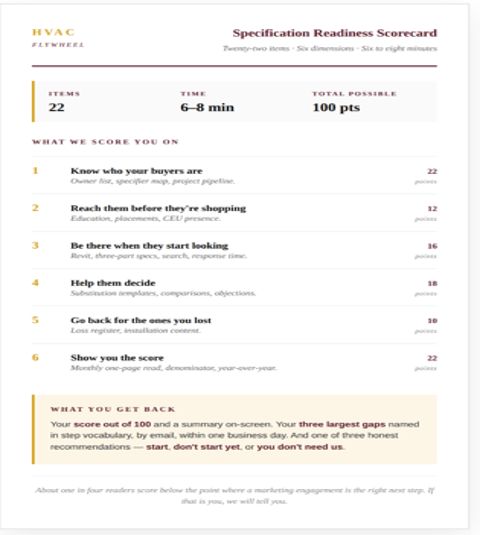
The Specification Readiness Scorecard is a written read of your current specification practice across the six steps. Twenty-two items. Six to eight minutes.
You will see your score and a summary the moment you finish. If you want the full written read — three specific gaps named in your own step vocabulary and how manufacturers typically close them — we send it by email within one business day.
The Scorecard produces one of three outcomes.
- If your score suggests you are already producing a measurable read, the honest answer is an engagement may not be your next best investment, and the report will say so.
- If your score suggests your gaps are foundational rather than tactical, the honest answer is a marketing program will not fix them, the report will name what should be done.
- If your score lands in the middle of the pack — where most manufacturers land — the report will name your three largest gaps and the direct you to request a detailed proposal.
No credit card. No obligation. Instant score. Written read within one business day.