Step 5 | THE RECOVERY ENGINE
A Loss is a Deferred Win.
Institutional standards revise every five to twenty years. Specifiers write specifications every four to eighteen weeks.
The wheel keeps turning after a loss — because the specifier who chose against you last year is writing another specification, for a different institution, right now.
Get Your Specifications Readiness Scorecard

The specifier does not disappear when the project does
Most HVAC manufacturers treat a specification loss as an event that closed.
The rep updates the CRM, the marketing team moves on to the next campaign, the file goes into an archive nobody opens.
The specifier who wrote the losing specification is either forgotten, quietly resented, or occasionally sent a follow-up email that arrives too late and reads too commercial.
This is a category error. Institutions have long revision cycles — five to twenty years between meaningful updates to a design standard — and manufacturers have quietly built their entire loss-recovery thinking around waiting for those cycles.
But the specifier who wrote the losing specification is not on the institution’s cycle. That specifier is a mechanical engineer at a design firm, writing three to eight specifications every year for various institutions across their metro.
The loss of a University this year is the same engineer writing a hospital renovation next year and a K-12 addition the year after.
You are not losing on price.
You are losing before price exists — and you are also losing the recovery, in the years after the loss, by treating the wrong unit as the atom.
The unit of value in specification-driven markets is the specifier, not the project and not the institution. Step 5 is what happens when a manufacturer actually operates on that truth.
30 lost institutions might involve only 12 unique specifiers — writing 36 to 96 specifications a year across everyone they work for.
Every one is a recovery opportunity, with the same specifier, without waiting for anyone’s revision cycle.
What our practice does at Step 5
Every specification loss triggers a written After-Action within two weeks, filed by institution and by specifier. Every lost institution and every lost specifier get a written Return Plan on two clocks: institutional revision cycles and specifier project frequency.
Every lost specifier stays inside your Cadence and your Reference Library, and gets flagged whenever the listening infrastructure detects them working on a new project anywhere — not just at the institution where you lost them. Engineer-fluent writing from Bill Merrow. AI-native production that makes the volume possible. Client engineering team review and signature on everything.
Step 5 is the step that turns the flywheel from a Year 1 growth program into a compounding relationship asset. Every quarter you run it, the portfolio of specifiers under active monitoring grows, the number of return plans in flight grows, the number of new-project alerts firing grows — and the practice’s ability to convert any given loss into a future win grows with it.
Our 6-Step Process
1 | The After-Action
Within two weeks of every specification loss, the practice conducts a structured written post-mortem.
Always. On every loss. Even when the specifier is uncommunicative or the intelligence is thin — a post-mortem with a “specifier declined to elaborate” note is still a post-mortem, and the file exists to be filled in over time.
Two sections in every document: institution-specific factors (what the winning spec named, price and lifecycle-cost comparison, political factors, what would need to change to win the institution’s next revision cycle) and specifier-general factors (what this loss reveals about the specifier’s technical preferences, standards approach, objection patterns, and communication style that generalize across their other work).
Filed by institution and by specifier — two indexes into the same document.
2 | The Return Plan
Every lost institution and every lost specifier gets a written return plan, on two tracks.
The Institution Track is dated to the institution’s revision cycle — when the standard is next up for revision, when the next capital-planning cycle opens, when the trigger points arrive to reappear in the institution’s decision environment. Long-horizon, executed through the Cadence and Reference Library infrastructure from Step 3.
The Specifier Track is rolling active status for every named specifier who chose against the client — quarterly touchpoints keyed to the specifier’s general professional presence, plus alerting when the listening infrastructure detects the specifier working on a new relevant project at any institution.
3 | The Return Cadence
Operational execution runs through Step 3’s existing Cadence infrastructure, but with different content for the lost-specifier segment.
If a specifier wrote against the client because of concerns about serviceability, they receive service-network updates as part of a rotation they do not know they are in.
Subtle by default — the specifier never receives content that names their past choice or reads as pursuit.
Where the client’s engineer has an active relationship with the specifier that would make an explicit reference feel like professional courtesy rather than manipulation, that reference is made.
Judgment call by the client’s engineer, case-by-case, never a policy the practice sets from the outside.
4 | The Watch
Two triggers, one listening infrastructure.
Standard-revision monitoring at every lost institution: when the University announces a Division 23 revision, every manufacturer who lost their spec in the last cycle should know within days, and the institution’s Return Plan fires into active mode.
New-project monitoring for every lost specifier at any institution: LinkedIn activity by design-firm principals, job postings signaling engineering-team growth for specific project types, construction-news announcements naming firms of record — all monitored for lost specifiers regardless of institution.
Both triggers fire the Recovery Campaign.
5 | The Recovery Campaign
Fires whenever an active recovery opportunity emerges — an institution’s revision cycle opening, or a lost specifier’s new project surfacing at any institution.
Uses the same Active Project Briefing infrastructure from Step 4, tuned with the historical loss context: what this specifier chose against the client for last time, what technical case the competitor made, what the client would need to do differently this time to change the outcome.
Runs for the duration of the opportunity window, typically six to eighteen months for a standard revision and three to nine months for a specifier’s new project.
6 | The Recovery Score
Monthly, one page, delivered five business days after month-end.
Two dimensions: institution-level (Return Plans active, institutions approaching revision in the coming 12–24 months, standard-revision announcements caught this month, historical institution-cycle conversions) and specifier-level (lost specifiers under active monitoring, engagement with the Cadence and Reference Library, new-project alerts fired in the past 30 days, and recovery conversions — specifications won from previously-lost specifiers at any institution).
The Recovery Score becomes Step 5’s slice of the Monthly Accountability Review that runs the whole flywheel.
What makes Step 5 different from the loss-recovery thinking you have been taught
Most manufacturers treat loss recovery as “wait for the institution’s next revision cycle.” Some manufacturers treat it as “move on and focus on new business.” A few treat it as “send a follow-up email that arrives too late and reads too commercial.” All three approaches share the same category error: they treat the institution as the unit and the specifier as an interchangeable name inside the institutional context. That is the wrong atom.
Three things separate Step 5 from the loss-recovery thinking you have been taught.
One, the atom is the specifier, not the institution.
Institutional standards revise on five-to-twenty-year cycles. Specifiers write specifications on four-to-eighteen-week cycles.
The specifier who chose against you on the new Hospital wing is writing three to eight specifications a year across everyone they work for.
Every one of those is a recovery opportunity that a competitor still thinking institutionally will never see.
Two, every loss produces a written After-Action — including the losses where the specifier will not talk.
The After-Action file exists whether the specifier cooperates or not.
A post-mortem with a “specifier declined to elaborate” note is still a post-mortem — and over the years, as more specifications from the same specifier accumulate, the file gets richer.
The competitor who never files a post-mortem on a thin-intelligence loss will not have the pattern recognition three years later when the same specifier surfaces on a new project.
Three, the listening infrastructure watches specifiers, not just institutions.
The Watch monitors both clocks in parallel.
When an institution announces a standard revision, the practice knows within days. When a lost specifier surfaces on a new project at any institution — through job postings, LinkedIn activity, construction news, or the Working Room — the practice knows within days.
Both signal types fire the same Recovery Campaign. No other approach the market offers watches both clocks.
Seeding the future. Harvest occurs when the specifier is ready.
Step 5 is measured differently than the other steps in Year 1.
The Recovery Score in Year 1 shows Return Plans built, specifiers under active monitoring, and new-project alerts fired — leading indicators of recovery, not primarily recovery conversions themselves.
Conversions accumulate in Years 2 and 3 as the earliest lost specifiers reach their next project fires and the earliest lost institutions approach their next revision cycles. This is the honest shape of specifier-clock recovery work.
The client who understands institutional buying will recognize this as valuable. A Return Plan portfolio built in Year 1 is not sitting idle — it is compounding, quietly, waiting for the trigger events that convert Return Plans into won specifications. By Year 3 of a Step 5 engagement, the harvest is not theoretical.

What you have after Year One of Step 5
A written After-Action for every specification loss in the past twelve months, filed by institution and by specifier.
A Return Plan for every lost institution, dated to the institution’s revision cycle.
A Return Plan for every lost specifier, tracking their professional presence and their new projects at any institution.
Return Cadence content flowing to lost specifiers through the Step 3 infrastructure, addressing the reasons they chose against you last time.
Standard-revision monitoring at every lost institution and new-project monitoring for every lost specifier — both triggers wired to the same Recovery Campaign infrastructure.
A monthly Recovery Score showing institution-level and specifier-level activity, alerts fired, and — as they accumulate — recovery conversions.
A specifier-relationship asset that grows every quarter and that a competitor cannot replicate without running Step 5 for as many years as you have.
Before you decide, see where you actually stand
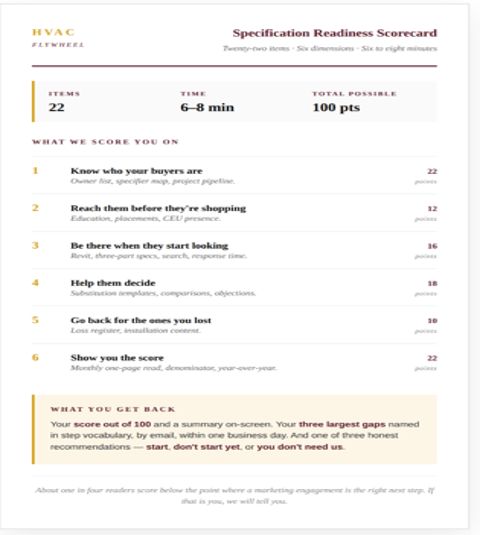
The Specification Readiness Scorecard is a written read of your current specification practice across the six steps. Twenty-two items. Six to eight minutes.
You will see your score and a summary the moment you finish. If you want the full written read — three specific gaps named in your own step vocabulary and how manufacturers typically close them — we send it by email within one business day.
The Scorecard produces one of three outcomes.
- If your score suggests you are already producing a measurable read, the honest answer is an engagement may not be your next best investment, and the report will say so.
- If your score suggests your gaps are foundational rather than tactical, the honest answer is a marketing program will not fix them, the report will name what should be done.
- If your score lands in the middle of the pack — where most manufacturers land — the report will name your three largest gaps and the direct you to request a detailed proposal.
No credit card. No obligation. Instant score. Written read within one business day.