Step 6 | THE ACCOUNTABILITY RHYTHM
The Report Is the Agenda. The Meeting Is the Practice.
You do not need another marketing report. You need a monthly hour with someone who has been in your industry for decades, looking at your specification-marketing numbers with your leadership team in the room, and walking out with written corrective actions that get done.
Get Your Specifications Readiness Scorecard

Why marketing reports do not change what happens next monthct does
Every marketing agency and every produces reports.
Dashboards, slide decks, monthly summaries, quarterly reviews. The reports arrive in your inbox, get skimmed by whoever has time, and change nothing.
The same issues appear the next month, the month after that, and the month after that — because a report by itself does not force anyone to make a decision.
The manufacturers who actually convert marketing spend into won specifications do one thing differently.
They have a standing monthly meeting with their leadership team in the room where the marketing numbers are opened, debated, and turned into corrective actions before anyone leaves.
The rhythm is what creates accountability. The report is only the agenda.
You are not losing on price.
You are losing before price exists — in the weeks between reports nobody read, when corrective actions were never assigned, when drifting metrics kept drifting.
Why? Because no one was in a room where the drift had to be answered.
What our practice does at Step 6
A one-page monthly Score synthesizing every metric from Steps 1–5, delivered five business days after month-end. A standing 90-minute Monthly Accountability Review with your leadership team, always the same week, always the same day and time, always the same people in the room, always facilitated by Bill Merrow.
Every drifting metric gets a written corrective action — owner, action, deadline, support required — before the meeting closes. Nothing leaves the room undecided.
Step 6 is the reason the other five steps produce results instead of drifting. Steps 1–5 do the work; Step 6 is the discipline that makes sure the work turns into won specifications rather than a growing archive of activity nobody reviews.
Our 6-Step Process
1 | The Score
A one-page monthly synthesis of every metric from Steps 1–5, delivered 5 business days after month-end.
Five sections, one per upstream step: Buyer Book Health from Step 1, Discovery Score from Step 2, Engagement Score from Step 3, Decision Score from Step 4, Recovery Score from Step 5 - plus a three-sentence summary at the top: what we did last month, what it produced, what we are doing next.
The one-page constraint is not decorative. A report that does not fit on one page becomes a document nobody reads. A report that fits on one page becomes the agenda for a meeting.
2 | The Success Drivers Register
A living document identifying the specific metrics that actually drive outcomes for your organization at this specific moment in your flywheel maturity.
A hundred metrics exist across Steps 1–5; roughly ten of them matter for you right now. The Score reports all the metrics; the Monthly Review focuses on the Success Drivers.
Which metrics count as Success Drivers shifts over time — in Year 1 typically Buyer Book completion and Discovery Score; in Year 3 typically Engagement Score depth and early Recovery conversions; in Year 5 typically Recovery Score compounding and specifier-relationship portfolio value.
The Success Drivers Register is updated quarterly with your leadership team so the Monthly Review is always focused on what matters most this quarter.
3 | The Action Plan
A single-page action plan for each Success Driver, listing owner, action, deadline, and the support required from the practice or from other members of your leadership team.
Updated after every Monthly Accountability Review.
Lives on a single page your leadership team can see at any moment — which is where marketing programs stop dying, because there is no longer a gap between “we should do this” and “someone is doing this by when.”
4 | The Accountability Review
The core of Step 6. A 90-minute standing appointment on your leadership calendar, always the same week of the month, always the same day and time, always attended by the same people.
Bill facilitates. First 15 minutes: the three-sentence summary at the top of the Score. Next 45 minutes: ten minutes per step for Steps 1–5 — metrics against goal, what is on track, what is drifting, which one or two Success Drivers within that step need leadership attention this month.
Final 30 minutes: the Corrective Action Session — every drifting metric gets a written corrective action before the meeting ends, read aloud before the meeting closes.
The meeting is the deliverable, not the report. The report is the agenda. The corrective actions are the outputs.
5 | The Corrective Action Log
A running log of every corrective action from every Monthly Review, with completion status.
Updated between meetings by your designated internal owner of flywheel execution, and reviewed at the top of the next month’s Review.
Every corrective action either gets done, gets rescheduled with a reason, or gets escalated — and the leadership team sees the pattern of which corrective actions actually complete and which quietly disappear.
That pattern is often the single most useful diagnostic the Monthly Review produces.
6 | The Quarterly Recalibration
Every three months, the Monthly Accountability Review is expanded to include a recalibration of the Success Drivers themselves.
What changed in your market.
What changed in your flywheel’s maturity.
What changed in the competitive environment.
Which Success Drivers should shift focus next quarter.
This is what keeps Step 6 from becoming a rote monthly ritual that stops responding to what your business actually needs.
What makes Step 6 land inside your organization
Every month between our Reviews, corrective actions we agreed on need to get done inside your organization. That work does not happen on its own, and it does not happen well if it gets distributed across a leadership team already carrying full plates.
What separates clients whose flywheel produces results from clients whose flywheel drifts is a single internal person you name — someone who owns making sure the corrective actions we decided together actually happen in the four weeks before we meet again. They do not need to be senior. They need to be organized, they need to be trusted by your leadership team, and they need to have this as a formal part of their job description. We will help you scope the role and identify the right person during onboarding.
Every marketing agency produces reports. Some produce dashboards. A few will attend a monthly call to walk through the numbers. If any of it had converted into won specifications for your organization, you would not still be evaluating the practice.
Three things separate Step 6 from the reporting programs you have been sent.
One, the meeting is the deliverable, not the report.
Reports do not produce accountability. Meetings do.
The Score is a one-page agenda designed to be opened together in a room with your leadership team and turned into written corrective actions before anyone leaves.
Without the meeting, no report ever produced by any agency changes what happens next month.
Two, the rhythm is the mechanism.
Same week of the month. Same day and time. Same people in the room. Ninety minutes. Never skipped.
The discipline of the standing appointment — more than any single report or corrective action — is what turns intent into results.
Miss two in a row and the flywheel is failing regardless of what any metric says.
Hold every one and the flywheel produces results a competitor cannot replicate without the same discipline.
Three, the corrective actions leave the room decided.
Every drifting metric gets a written corrective action before the Monthly Review closes.
Who owns it. What they will do. By when.
What the practice will support. What leadership needs to authorize or resource.
Read aloud before the meeting ends.
Nothing leaves the room undecided — which is the gap where every other marketing program you have hired has died.

What you have after Year One of Step 6
Twelve monthly Scores on the record, delivered five business days after every month-end.
Twelve Monthly Accountability Reviews held with your leadership team, facilitated by Bill Merrow.
A current Success Drivers Register naming the ten or so metrics that actually drive outcomes for your organization at this stage of flywheel maturity.
An Action Plan for every Success Driver, updated after every Monthly Review, visible to your leadership team on a single page.
A Corrective Action Log showing every action assigned across twelve reviews, its completion status, and the diagnostic pattern that reveals which actions actually finish inside your organization.
Four Quarterly Recalibrations that have adjusted the Success Drivers as your business, market, and flywheel maturity evolved.
An accountability rhythm your organization has never had before — and that will not disappear when the retainer ends, because the discipline is now inside your leadership team.
Before you decide, see where you actually stand
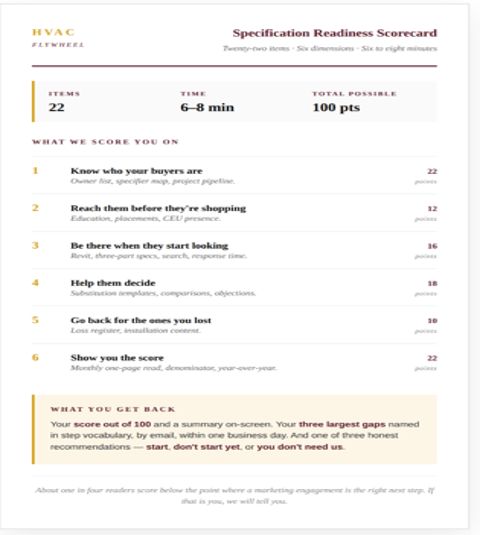
The Specification Readiness Scorecard is a written read of your current specification practice across the six steps. Twenty-two items. Six to eight minutes.
You will see your score and a summary the moment you finish. If you want the full written read — three specific gaps named in your own step vocabulary and how manufacturers typically close them — we send it by email within one business day.
The Scorecard produces one of three outcomes.
- If your score suggests you are already producing a measurable read, the honest answer is an engagement may not be your next best investment, and the report will say so.
- If your score suggests your gaps are foundational rather than tactical, the honest answer is a marketing program will not fix them, the report will name what should be done.
- If your score lands in the middle of the pack — where most manufacturers land — the report will name your three largest gaps and the direct you to request a detailed proposal.
No credit card. No obligation. Instant score. Written read within one business day.